



Canopy Footing Types

There are many misconceptions when it comes to aluminum canopy footings. We have seen many times where aluminum canopy footers are designed too large or are designed as if it were a steel structure. This section will lay out the different criteria to consider when designing footers for aluminum canopies and clear up any misconceptions in canopy footing design.

There are three main factors to consider when designing a canopy footing:

  1. Bearing Load
  2. Wind Uplift
  3. Moment created due to horizontal loading on the canopy (typically wind loading)
  1. Bearing Load – Bearing load determines the width of the footer or what we call the footer “pad.” Bearing load is the weight that the aluminum canopy is putting down on the footer (through the canopy column). The way to make sure that your canopy footing is large enough to withstand the bearing load is simple: the weight of the canopy under full loading must be able to be held up by the ground and not sink in. An easy analogy for this is a pencil in dirt. If the force of the pencil is greater than the dirt can withstand, the pencil will sink. If the force of the pencil is less than the dirt can withstand, the pencil will not sink. 

    The minimum soil condition for the United States is typically 1500 lbs/ft^2 (this is for sandy conditions, but can be used as worst case scenario). The specific site conditions can be verified by a geotechnical survey. To figure out what size the bottom dimension of the canopy footing needs to be, take the total load going through the column and divide it by the allowable psf of the site soil conditions. This will give you the square feet that the bottom of the footer needs to cover. 
  1. Wind Uplift – Wind uplift determines the overall size of the footer. Canopy footing size will vary depending on which part of the country it is being installed due to varying wind conditions. This is typically the hardest factor to calculate because you are determining how the wind is going to affect the canopy. ASCE 7-05 will give you the most accurate information on how wind speed affects the canopy. On average, concrete weighs 144 lbs/ft^3. The way to calculate a minimum footer size is to determine the amount of uplift (in lbs) the wind is applying to the canopy at each column, then divide that force by 144 and that will give you the minimum cubic feet of concrete needed to keep the canopy in place. After calculating the minimum cubic feet of concrete, remember that varying dimensions can give you the same cubic feet of concrete (ex: an 18”x18”x24” footer is roughly the same amount of concrete as a 13”x13”x40” footer). This is where you need to make sure to incorporate the minimum footer pad size from your bearing load calculations. Also, do not forget that the aluminum column creates a void in the concrete, so the footing size will need to account for this.
  1. Moment Created due to Wind Loading – The moment acting on the canopy determines typically how deep the footer should be. The moment is basically the force created by horizontal wind wanting to tip the canopy over. Canopy footing must be deep enough to resist this "tipping" force, but also remember that the canopy framing will resist the moment as well with its fixed connections. IBC 2006 can be used to help determine footer depth by using equations 18-1 or 18-2.

*Tips for Designing Footers*:

Here is a list of tips to keep in mind when designing aluminum canopy footing, so that your footers are not over or under-designed.

  1. Aluminum is much lighter than steel, so the footer “pad” size for an aluminum canopy will be much smaller than that of a steel canopy.
  2. A footer’s depth is typically based on the moment created by wind loading, but another factor in a footer’s depth is the frost line for the area the canopy is being installed. A canopy’s footer must be deeper than the frost line for that particular area to prevent the frost from pushing the footer and canopy out of the ground.
  3. Footers for cantilevered canopies are deeper than standard canopy footing due to cantilevered canopies having a much higher moment on the column.
  4. Aluminum reacts negatively with concrete. A bituminous coating applied to the aluminum will stop any reaction between the aluminum and concrete. A baked enamel finish qualifies as a bituminous coating. If the canopy is anodized aluminum, an acrylic coating must be applied to the column where it will contact the concrete footer to stop any reaction between the two.
  5. For a typical canopy being installed in the southeast, not in a high wind region, an average footer size would be 18”x18”x20” for each column.
  6. There are multiple aluminum canopy footing styles. Below is a list of some examples.
    1. Standard Footer using 8”x8”x6” Styrofoam block-out
    2. Standard Footer using 8”x8”x12” Pyramid Styrofoam block-out
    3. Slab Mounting of column using welded base plates with SS epoxy anchors or SS wedge anchors
    4. Standard Footer with underground drainage connection
    5. Slab Mounting of columns using MM Slab Mount Brackets with SS wedge anchors

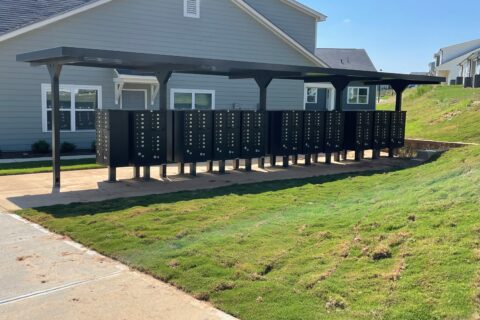
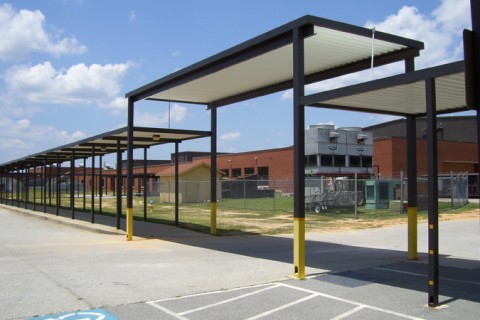
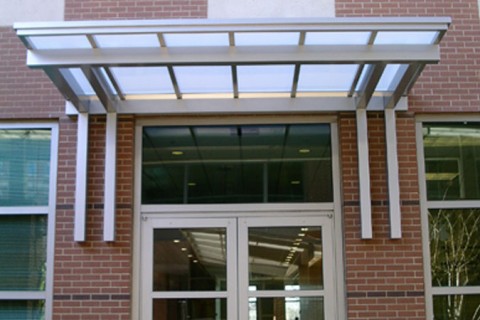
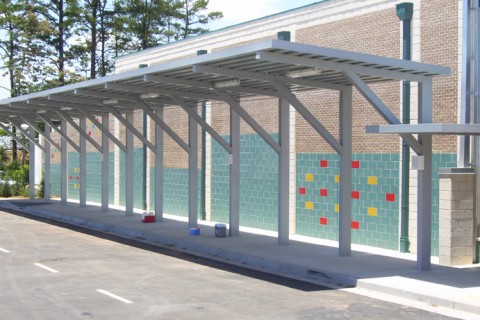
Contact us by using the form on the right or see some of our previous projects with customized canopy footing.

Footer Types

Learn about our canopy footing parts.

Standard Footer w/
8" x 8" x 12" Pyramid Blockout

Download DWG .zip

Download PDF PDF


Standard Footer Slab Mounted

Download DWG .zip

Download PDF PDF


Standard Footer w/ Base Plate

Download DWG .zip

Download PDF PDF


Standard Footer w/
Underground Drainage

Download DWG .zip

Download PDF PDF


Need more information on a project?

First Name

Last Name

Email Address

Confirm Email Address

Company Name

Project Details

Phone Number

We respect your privacy. No information will be given to 3rd parties.